Friday, February 22, 2019

Albemarle (ALB) Releases Quarterly Earnings Results, Beats Expectations By $0.06 EPS

Albemarle (NYSE:ALB) issued its earnings results on Wednesday. The specialty chemicals company reported $1.53 earnings per share for the quarter, topping the Thomson Reuters’ consensus estimate of $1.47 by $0.06, Bloomberg Earnings reports. Albemarle had a return on equity of 15.39% and a net margin of 10.44%. The company had revenue of $921.70 million during the quarter, compared to the consensus estimate of $894.45 million. During the same quarter in the prior year, the business earned $1.34 earnings per share. The company’s revenue was up 7.4% compared to the same quarter last year. Albemarle updated its FY 2019 guidance to $6.10-6.50 EPS and its FY19 guidance to $6.10-6.50 EPS.

ALB traded down $0.32 on Wednesday, reaching $82.81. The company’s stock had a trading volume of 1,765,236 shares, compared to its average volume of 1,521,320. The company has a market capitalization of $8.83 billion, a P/E ratio of 18.04, a P/E/G ratio of 0.82 and a beta of 1.60. Albemarle has a 1 year low of $71.89 and a 1 year high of $118.83. The company has a debt-to-equity ratio of 0.38, a quick ratio of 1.18 and a current ratio of 1.83.

Get Albemarle alerts:

ALB has been the subject of several analyst reports. reaffirmed a “buy” rating and issued a $157.00 target price on shares of Albemarle in a research report on Thursday, February 14th. KeyCorp reaffirmed an “overweight” rating and issued a $120.00 target price (down previously from $140.00) on shares of Albemarle in a research report on Tuesday, December 18th. Zacks Investment Research raised Albemarle from a “hold” rating to a “buy” rating and set a $107.00 target price for the company in a research report on Monday, November 26th. HSBC raised Albemarle from a “hold” rating to a “buy” rating and set a $112.50 target price for the company in a research report on Monday, December 10th. Finally, Berenberg Bank downgraded Albemarle from a “buy” rating to a “hold” rating and decreased their target price for the stock from $120.00 to $78.11 in a research report on Thursday, January 3rd. Three analysts have rated the stock with a sell rating, five have assigned a hold rating and twelve have assigned a buy rating to the company’s stock. Albemarle has a consensus rating of “Hold” and an average price target of $108.76.

In related news, EVP Karen G. Narwold sold 1,295 shares of the stock in a transaction dated Friday, January 4th. The stock was sold at an average price of $74.76, for a total value of $96,814.20. Following the completion of the transaction, the executive vice president now owns 31,028 shares of the company’s stock, valued at $2,319,653.28. The sale was disclosed in a document filed with the Securities & Exchange Commission, which is available at the SEC website. Also, EVP Karen G. Narwold sold 3,100 shares of the stock in a transaction dated Monday, November 26th. The shares were sold at an average price of $96.54, for a total value of $299,274.00. Following the completion of the transaction, the executive vice president now directly owns 27,142 shares of the company’s stock, valued at approximately $2,620,288.68. The disclosure for this sale can be found here. Insiders sold 7,738 shares of company stock valued at $645,309 in the last three months. 0.80% of the stock is currently owned by company insiders.

TRADEMARK VIOLATION NOTICE: This article was posted by Ticker Report and is the property of of Ticker Report. If you are accessing this article on another domain, it was stolen and reposted in violation of US & international trademark and copyright laws. The correct version of this article can be viewed at https://www.tickerreport.com/banking-finance/4166977/albemarle-alb-releases-quarterly-earnings-results-beats-expectations-by-0-06-eps.html.

About Albemarle

Albemarle Corporation develops, manufactures, and markets engineered specialty chemicals worldwide. Its Lithium and Advanced Materials segment offers lithium compounds, including lithium carbonate, lithium hydroxide, lithium chloride, and lithium specialties, as well as reagents, such as butyllithium and lithium aluminum hydride for applications in lithium batteries for consumer electronics and automobiles, high performance greases, thermoplastic elastomers for car tires, rubber soles, plastic bottles, catalysts for chemical reactions, organic synthesis processes, life science, pharmaceutical, and other markets.

Read More: What is a Derivative?

Earnings History for Albemarle (NYSE:ALB)

Wednesday, February 20, 2019

LendingClub Corp (LC) Q4 2018 Earnings Conference Call Transcript

Logo of jester cap with thought bubble.

Image source: The Motley Fool.

LendingClub Corp  (NYSE:LC)Q4 2018 Earnings Conference CallFeb. 19, 2019, 5:00 p.m. ET

Contents: Prepared Remarks Questions and Answers Call Participants Prepared Remarks:

Operator

Good day, and welcome to the LendingClub Fourth Quarter 2018 Earnings Call. All participants will be in a listen-only mode. (Operator Instructions) After today's presentation, there will be an opportunity to ask questions. (Operator Instructions) Please note this event is being recorded and broadcast over the Internet.

I would now like to turn the conference over to Simon Mays-Smith VP of Investor Relations. Please go ahead.

Simon Mays-Smith -- Vice President of Investor Relations

Thank you, Shawn and good afternoon, everyone. Welcome to LendingClub's 2018 fourth quarter earnings conference call. Joining me today to talk about our results and recent events are Scott Sanborn, CEO; and Tom Casey, the CFO.

Our remarks today will include forward-looking statements that are based on our current expectations and forecasts and involve risks and uncertainties. These statements include, but are not limited to, our guidance for the four quarter and full year 2019. Our actual results may differ materially from those contemplated by these forward-looking statements. Factors that could cause these results to differ materially are described in today's earnings press release and our most recent Form 10-K and Form 10-Q filed with the SEC. Any forward-looking statements that we make on this call are based on assumptions as of today and we undertake no obligation to update these statements as a result of new information or future events.

Also, during this call, we will present and discuss both GAAP and non-GAAP financial measures. A description of non-GAAP measures and reconciliation to GAAP measures are included in today's earnings press release. The press release and accompanying presentation are available through the Investor Relations section of our website at ir.lendingclub.com.

And now I'd like to turn you over to Scott.

Scott Sanborn -- Chief Executive Officer, Director

Thank you, Simon. Hello, everyone. I am pleased to say that we delivered a very strong 2018, achieving for the year new record highs in originations, revenue and adjusted EBITDA. We are demonstrating the resilience and adaptability of our business, successfully navigating a dynamic and competitive market, in which we continue to deliver savings to borrowers now burdened by the highest credit card interest rates in a decade while simultaneously delivering attractive risk-adjusted returns to investors, struggling to find yield.

We've come a long way in the last few years. Having stabilized the business in 2017, we demonstrated strong momentum in 2018, despite rising interest rates, capital market volatility, competitive intensity, tightening credit and substantial shifts in investor demand toward higher quality credit.

We are gaining share and enhancing our competitive advantage through data-driven innovation at scale, marketing excellence, and our cost-of-capital advantage. We are integrating more closely with our customers and developing more tools and partnerships to improve our borrowers' financial health.

In 2019, we will drive responsible revenue growth with a significant management focus on delivering more revenue to the bottom line. We're taking further steps to simplify our business and are targeting adjusted net income profitability over the second half of this year.

Our strong results last year reflect solid execution of the plan we laid out for you back at our Investor Day in December 2017, the capital allocation decisions we've made to support those plans and the market context in which we operate.

I'm going to spend a minute on each of these topics. Our plan at Investor Day had four pillars. First, continue to grow our personal loan business while prudently managing credit; second, sustain our investment in auto and eventually leverage secured capabilities for personal loans; third strengthen our investor franchise by expanding securitization and growing new structures; and finally address legacy issues. We've made tremendous progress in all four of these areas.

In personal loans, we grew applications in 2018 by 35% to a total of more than 14 million. Loan volumes and revenue both grew by 21% and we enhanced our market leadership while simultaneously improving our marketing efficiency. We achieved these results despite proactively tightening credit in our standard program by 17% and raising interest rates across our credit spectrum by between 49 and 114 basis points.

We are succeeding, because we can offer lower rates to higher-quality borrowers than many of our competitors. The compelling value we offer to borrowers is rooted in our marketplace model's ability to connect to low-cost capital providers, the unique products and processes we have developed to enable the seamless extension of credit, our proprietary risk models built on more than 10 years of data and our ability to test and learn at scale.

In auto, improvements in the customer experience reduced application processing time by 80% and doubled our application-to-issuance rate, helping to increase throughput in more than double originations in 2018. While origination volume has not been our core focus in auto and remains small in the overall scheme of LendingClub, some context might be helpful.

Auto originations since launch are three times higher than personal loans at the same point in their life cycle. So we remain encouraged of auto as a long-term driver of our growth. Having developed the user experience and credit model in 2018, we will be focusing on building out our investor base in auto in 2019.

Turning to our investor franchise, where product innovation has driven a significant transformation over the last 18 months and enabled us to access ever-larger pools of capital. It's worth noting that investors provided funding for more than $10 billion in loans last year, a figure which represents almost a quarter of the total loans facilitated in our entire decade-plus history.

Investors continue to be attracted to our high-yield short-duration asset, which in 2018 outperformed 99% of fixed income assets, providing further compelling evidence of their diversification benefits. In 2019, we'll be focused on more deeply integrating with our largest investors becoming more a part of their investment process and actively managing the delivery of targeted returns for their portfolios.

Finally, the last pillar of our Investor Day plan was resolving legacy issues where we made significant progress last year. We settled the class action lawsuits in February and resolved both the DOJ and the FTC in October. As concerns the FTC, the government shutdown has hampered progress. While we maintain that the facts do not support the allegations in their complaints, we absolutely share the goal of wanting to help consumers.

To that end, we will be proactively implementing changes to our application process to further cement our position as an industry leader of consumer-friendly practices. Tom, will show you how we measured up financially in 2018, but as I'm sure you have already seen we achieved or exceeded all of our goals.

So now, let's talk about how our capital allocation initiatives helps us deliver on our promises in 2018 and how they set us up for 2019 and beyond. Our decision to invest either organically or through acquisitions and to fund those decisions through cash flow, process efficiencies or divestments are taken within a clear capital allocation framework that seeks to maximize our market opportunity, while sustaining strong liquidity and managing operational and regulatory risk.

Our goal remains to enhance our position in areas where we have clear competitive advantage and to exit or partner where we don't. In addition to our investment in auto, our organic investments in our platform, products and process are reinforcing the strength of our personal loan marketplace, first by growing borrower demand and funnel efficiency, and second by expanding our addressable investor asset pools.

Our demand generation has been phenomenal. We've been able to grow applications while sustaining our marketing efficiency in a competitive market despite raising interest rates and tightening credit. We've been able to do this by leveraging our scale to optimize through testing with more than 100 tests in Q4 alone and through refinements to our targeting models and messaging.

In throughput, our investments in product, process and partnerships are improving the customer experience and converting more applicants to borrowers. Expanded product features such as joint app and balance transfer and improved data collection from bank and tax data are helping us to reduce funnel friction and improve our credit assessment. This is augmented by improved omni-channel customer support across online, messaging, and mobile.

In combination, our demand generation and throughput initiatives improved both the customer experience and our marketing efficiency. As evidence to the progress, we're making here in 2018, 58% of our personal loan customers went from application to approval within 24 hours. This is up from 41% in 2017. Given these improvements, it's perhaps not surprising that last year we hit an all-time high Net Promoter Score of 78. While we've made tremendous progress on funnel conversion much opportunity remains.

In 2018, we generated 14 million personal loan applications though we helped only 728,000 of those applicants with a loan. We want to make sure that we help more customers on their path to financial health and build a lifetime relationship with LendingClub members.

We are continuing to explore ways to say yes to more in a way that is prudent and responsible both through our own efforts and those of partners and to find ways to further reduce friction in the process. We are personalizing the experience for the growing number of returning customers and you'll see more ways for us to increase the value of being a member of the club in 2019.

On the investor side of the platform, we made tremendous progress. The presence of some of the largest asset managers in the world on our platform something that wasn't true even a year ago is a testament to the appeal of the asset and the breadth and quality of capital that we are now attracting. At the same time, it's making our platform more accessible to new sources of capital we're integrating with our largest customers more deeply. In sum, our investment contributed to our strong revenue and EBITDA performance in 2018 and will continue to benefit us in 2019 and beyond.

So let's move on to the next part of our capital allocation process, which is our operational footprint and expense management. You've seen some of the progress we made in 2018 with the winding down of LendingClub Asset Management, and we're continuing to explore opportunities to simplify our portfolio. As Tom will talk about more, our business process outsourcing partnerships enable us to lower our unit cost, shift more of our cost to a variable basis, and focus our engineering and operations talent on areas of competitive advantage. Partnerships are also an important part of our membership strategy. Adding high-quality partners that align with our mission has the potential to meaningfully contribute to our customers' financial health by providing them with additional ways to save, while simultaneously providing opportunities to grow our business.

As you know we've also been reshaping our physical footprint adding capacity in Utah and reducing our square footage in San Francisco. This move provides for enhanced business continuity, while lowering unit costs across the company.

We'll continue to assess our operations in any organic investment, divestments, partnerships, or acquisitions that closely align with our strategic and financial goals. And as Tom will talk about in a bit more detail, we are laser-focused on simplifying our business to drive productivity and fuel our growth.

Our capital allocation decisions enabled us to maintain our leadership position, healthily grow revenues, and more than double our EBITDA. There what will deliver adjusted net income profitability over the second half of 2019 and beyond that, we believe the intrinsic scale and operating leverage in our marketplace will generate cash flows to sustain our growth investment, and over time, generate excess capital to return to shareholders.

Let's have a look at the market context in 2018 which will set us up to discuss the year ahead. For 2018, wage growth and low unemployment made conditions generally benign for the consumer, although rising debt levels have made consumers more sensitive to higher rates and less able to find savings from refinancing fixed-rate mortgages and student loans.

Capital markets have tempered expectations for future rate increases. As a whole charge-off rates and delinquencies remain stable and we have taken credit and pricing actions to resolve normalization and supply side driven pockets of weakness.

Competitive intensity remains high, but stable. Our competitive advantages in scale, data, marketing, cost of capital, and credit continue to give us an edge. We were particularly pleased that our marketplace did not miss a beat in 2018 despite dynamic movements in our markets and that gives us confidence as we enter 2019.

So far, in 2019, market conditions are similar to last quarter. We demonstrated resilience last year and we will be enhancing that resilience given the uncertain macroeconomic outlook for 2019 with borrowers who are investing in our service and capabilities to better support customers and lower the unit cost of providing that support with our second site in Utah and our BPO partnerships.

In credit, we continue to add data to our model to refine our assessment and selectively tighten credit to meet investor return requirements. We're pricing confidently using our data and cost-of-capital advantage to avoid adverse selection. And our investments in products, features, and partnerships are enabling us to improve funnel conversion and lifetime value.

We've developed broad distribution capabilities that give us alternative routes to market, improve the velocity of our balance sheet, give us better price discovery, and ultimately, lower the risk premium for our products. We are using these channels to manage our overall risk exposure and have new investor products coming to market in 2019 to further expand our capacity.

And finally, our simplification program will help us manage our profitability and sustain our investments in an uncertain environment. We will continue to allocate our capital carefully whatever the economic weather.

So to finish, in 2019, we remain committed to helping improve the financial health of borrowers and deliver attractive risk-adjusted return to lenders. Our work will be focused in three areas; first, growing responsively while prudently managing credit; second, continuing to carefully allocate capital innovating for long-term growth, while managing operational and regulatory risk; and third simplifying our operations and costs, targeting adjusted net income profitability over the second half of 2019.

When we look back at this time next year, I expect that 2018 and 2019 will be seen as pivotal years in the development of the company. Over the last few years LendingClub has been tested and emerged stronger. We have enormous opportunity ahead of us and are well placed to capture it.

None of this could have been achieved without the hard work and innovation from the employees at LendingClub and our partners and I'd like to take this is an opportunity to thank each and every one of them.

With that I'll turn it over to Tom for a look at the financials.

Thomas Casey -- Chief Financial Officer

And thanks Scott. I'm going to start by reviewing how we performed against the 2018 financial goals we set out at our Investor Day in December 2017. I'll then review our Q4 and full year performance before talking more detail about our simplification efforts and how that will help us achieve our 2019 financial goals of sustainable revenue growth and adjusted net income profitability over the second half of the year.

In our December 2017 Investor Day, we set several financial goals for 2018 and are happy to report we exceeded all of them. At $695 million, our revenues were above the midpoint of our expected range, at 48.8% our contribution margin was toward the top end of our expected range. Our tech and G&A expenses as a percent of revenues came in about 80 basis points better than our target.

For the year our adjusted EBITDA margins came in at 14% exceeding the high end of our expected range for the year and we delivered our goal of achieving 15% margins in the third quarter and the fourth quarter. And finally our full year adjusted EBITDA was $97.8 million exceeded the high end of our expected range.

So in short, we feel good about our strong Q4 and the full year 2018 results. Before I start on the details for 2018, unless I specify otherwise, all growth rates will be year-over-year. So let's start with revenue. On the borrower side of the platform, transaction fees grew 18% in Q4 to $142 million on the back of 18% growth in originations at $2.9 billion.

For the year, transaction fees grew 17% to $527 million and originations grew 21% to $10.9 billion. But the strong reported growth really only tells half the sorry. What I found particularly encouraging was the flexibility and adaptability shown by our marketplace in response to changing investor demand and our ability to match borrowers to that demand.

You can see that in the shifting mix of our loan volume with higher grade A and B loans in the standard program growing from 45% in 2017 to 56% in 2018. This is an enormous shift and our platform handled it without missing a beat with only 15 basis points year-over-year decline in our transaction fee yield.

On other side of the marketplace, net revenue excluding transaction fees represents the revenue we earn on the investor side of our business. These revenues grew -- were up 10% to $39 million in Q4 and 33% to $168 million for full year. There are two things that I'd emphasize here. First, the growth of the investor side of the platform is increasingly being driven by our recurring investor fees which accounted for 16.5% of net revenues in 2018 up from 15.2% in 2017.

The second point I'd emphasize is, how innovative new products such as CLUB Certificates have allowed us to reach an entirely new investor base in the large fixed-income money market segment. Our industry-leading CLUB Certificates program reached $1.1 billion by year end with $478 million of that in the fourth quarter and that's up from $300 million in the third quarter. We're still only just scratching the surface on demand for this product and see it as yet another way LendingClub is innovating in the marketplace.

With that let's get into more detail on the investor side of the marketplace. Investor fees were up 25% to $30 million in the fourth quarter and up 32% to $115 million for the full year. This strong performance in part reflects the 50% annual growth in our loan servicing portfolio to $13.7 billion as well as a 16% increase in average servicing rate.

Gain on sale revenue was $11 million in Q4 and $46 million for the full year, up 2% in Q4 benefited from the higher sold volumes and average servicing rates I just mentioned and up 97% for the full year mostly driven by the structured programs that were launched in June of 2017 and active throughout the full year of 2018.

Net interest income at fair value adjustments were a $3 million loss in Q4 and $1 million gain for the full year with positive net interest income offset by fair value adjustments. It's important to note that much of the value of our structured program comes to the gain on sale line while many of the costs are reflected in the net interest income and fair value adjustment lines. This line item does move from quarter-to-quarter reflecting timing of purchases and sales between reporting periods.

Other revenue was $1 million for Q4 and $6 million for the full year. Overall, total revenue was $182 million in Q4 and $695 million for the full year, up 16% and 21%, respectively.

So, let's move to costs and how our efforts drove our adjusted EBITDA margins up 6.3 points year-over-year. Marketing and sales expenses were $67 million in Q4 and $261 million for the full year. For the year, M&S as a percent of originations was down seven basis points to 240 basis points, reflecting our conversion efforts and new products we introduced this year. The 17 basis point quarter-on-quarter improvement to 2.32% reflected these efforts as well as the timing of certain marketing campaigns and channel testing in Q3.

Origination and servicing costs were $24 million in Q4 and $94 million for the full year. O&S costs as a percent of originations were down four basis points for the full year benefiting from the BPO efforts we started earlier in the year which I'll talk about in a minute.

The improvements in both M&S and O&S efficiency boosted our contribution margin to 50.1% in Q4 and 48.8% for the full year, up 198 basis points and 176 basis points, respectively.

One of the key financial themes at our 2017 Investor Day was our focus on growing tech and G&A spend lower than revenue. So, let's talk about our excellent progress here. Engineering operating expenses were $23 million in Q4 and $90 million for the full year, down as a percentage of revenue by 113 basis points and 160 basis points, respectively.

Turning to G&A, expenses were $40 million in Q4 and $152 million for the full year, representing 21.9% of revenue in both periods and a 40-basis point and 291 basis point improvement for the quarter and the full year.

Overall, you can start to see the positive impact of our expense management it is having on our adjusted EBITDA margins and the benefits of our scale. When you combine our full year tech and G&A expenses, they grew only 7% on net revenue growth of 21%. This is what we described at last year's Investor Day.

This wedge between revenue and expense growth rates drove 4.5 points of the total 6.2 points in our adjusted EBITDA margin in 2018, with the other 1.7 points coming from a higher contribution margin from our improved marketing efficiency. And we think there is more margin expansion opportunity ahead. I'll talk about some of this new initiatives in a moment.

In the fourth quarter, we further benefited from higher contribution margin and lower overhead expense growth, resulting in adjusted EBITDA of $28 million in Q4, up 49% year-over-year and adjusted EBITDA margin of 15.7%, up 3.2 points. For the full year, adjusted EBITDA was $98 million, up 119% and adjusted EBITDA margins were up 6.2 points for 2017.

So let's now -- let's move down to the GAAP net income. The adjustment for stock-based compensation was $18 million in Q4 and $75 million for the full year, up 9% and 6% respectively. Depreciation and amortization and other net adjustments totaled $50 million in Q4 and $55 million for the full year.

Our adjusted net loss, which we are now defining to only exclude non-recurring and unusual items, therefore equaled a $4 million loss in Q4 and a $32 million loss for the full year. There is a reconciliation of this through the GAAP consolidated net loss on slide 20 of the presentation.

Moving on down to the P&L. Non-recurring cost totaled $96 million, including $54 million of legacy issue expense, a $35.6 million goodwill impairment in Q2 and $7 million in restructuring charges in Q4, reflecting early progress on our simplification program. Combining all these items, our reported GAAP consolidated loss was $13 million in Q4 and $128 million loss for the full year.

Before I turn to our simplification programs, one final word on our balance sheet. For the quarter, cash and cash equivalents was $543 million, up from $513 million in the third quarter. Also, I want to point out that on the year-end balance sheet you will see our loans held for sale at $840 million, reflecting the consolidation of our $300 million Q4 securitization until we sell the related residual interest. Most of the remaining $500 million year-end loans are being sold to investors in the opening weeks of 2019 through structured programs such as the block trades or CLUB Certificates.

With that, let's move on to our simplification program. Scott's already talked about how our capital allocation decisions are helping to drive revenue growth. I'll talk about how they are also driving profitable growth. I'll update you on the initiatives that contributed to our strong performance in 2018 and give details on some new initiatives that we expect to contribute to 2019 and 2020 GAAP net income growth.

These simplification initiatives fall to four categories: first, business process outsourcing; second, geolocation; third, leveraging our scale; and fourth, all other initiatives. We used the same capital principles that Scott set a moment ago to guide our work, with the aim of enhancing our position in areas we have clear competitive advantage and to exiting our partnering where we don't.

Our simplification program has five goals: first, to expand our margins even more; two, to further improve our customer service; three, to focus our engineering and operational capacity on our highest return initiatives; four to lower our unit cost; and five to increase our resiliency by increasing the percentage of costs that our variable.

So let's take each of those categories in turn and show how they help us achieve our goals. Let me start with business process outsourcing. We started our BPO program early last year and was both an important first step in our simplification program and also a critical contributor to our 2018 margin improvement. We've used BPO to build capacity in our members support collections and back-end credit verification. There are two important benefits for BPO. First, we are able to lower the unit cost to deliver loan servicing, while maintaining very high customer satisfaction and Net Promoter Scores and second we swapped fixed costs for variable costs, which gives us further resiliency over the economic cycle.

To give you some idea of the scale of our BPO work, by the end of 2018 we had a BPO headcount of more than 250 people and is a critical part of our future. We're also using BPO to help focus our engineering capacity on our core products. For example, in 2019 we will complete the transition of our growing loan servicing business to an off-the-shelf platform provided by a third-party. Initiatives like this are important contributors to focus our technology investments and benefit from our scale.

Having learned to successfully manage multiple remote sites through our BPO initiative we are now able to leverage that experience through workforce geo-location. Our announcement to open our Utah facility significantly reduces our unit, FTE and property costs enabling us to do more for less and benefiting our O&S, M&S, and G&A line items.

Just as we're simplifying the infrastructure, we use to support our customers, we're also simplifying the infrastructure that supports our business and leverages our scale. We are rigorously reviewing all of our vendor agreements they're in the process of either managing renewals or consolidating. These efforts will further drive margin expansion and should improve contribution margin as well as tech and G&A expenses.

Finally, as part of our deliberate capital allocation process, we conducted a bottoms-up review, or what I would call a zero-based budget of our cost base. We started this review in the fourth quarter last year and is just in the process of coming to a conclusion here in the first quarter. This process highlighted several areas of potentially significant opportunities in our processes and portfolio structure. We're in the process of developing our execution roadmap of each initiative. And while they are not all to be executed in the first quarter, we see benefits accruing to the bottom line in 2019 and 2020.

Our simplification program provides a number of opportunities to further leverage our scale and simplify our business operations and give us the confidence that we can continue to expand our adjusted EBITDA margin another five points and get us to adjusted net income profitable in the second half of 2019, with adjusted EBITDA margins approaching 20% as we end the year.

So let me finish with guidance for Q1 and the full year 2019. 2018 demonstrated our ability to use credit, price, mix and scale to dynamically adapt to changing marketplace conditions and points to the resilience of our business model. Our growth investments, simplification program and preparation for uncertain macroeconomic conditions provides us with additional resilience as we head into 2019. We expect the operational phasing of our business to be similar to 2018 with a seasonally slower Q1.

As Scott mentioned, we continue to selectively tighten credit and raise prices to manage returns to investors. We expect our restructuring charges to broadly breakeven for the year at the GAAP net income level with a net negative impact in the first half of the year offset by a positive impact in the second half of the year and into 2020.

We've excluded restructuring charges and legacy issues and nonrecurring items from both our GAAP consolidated net income and adjusted net income guidance to give you a better view on the underlying performance of the business. We'll update GAAP consolidated income guidance each quarter as we incur these charges.

Despite further credit tightening to manage returns to investors, we've had a solid start to the year and expect Q1 revenue growth of between 7% and 13% implying revenues of between $162 million to $172 million. We expect full year growth between 10% and 14% implying revenues between $765 million and $795 million.

For adjusted EBITDA, our guidance range for Q1 is $13 million to $18 million. For the full year our guidance range is $115 million to $135 million. The wide full year ranges for revenue and profit reflect some of the uncertainty we see in the macroeconomic environment, we'll look to tighten these ranges as we have a better sight throughout the year.

We expect stock-based compensation charges of approximately $18 million in Q1 and $81 million for the full year. We expect depreciation amortization and other net adjustment charges of approximately $15 million in Q1 and $63 million for the full year. And we therefore expect GAAP net loss of between $15 million and $20 million in Q1 and $9 million to $29 million for the full year.

And as I mentioned earlier, we are targeting adjusted net income profitability over the second half of the year. This expected swing from adjusted net income loss to profit during 2019 marks an important inflection point for LendingClub. While, we still have a lot of work to do the opportunity to grow our profitability and further build resiliency in our marketplace give us further confidence in 2019 and beyond.

Scott, back to you.

Scott Sanborn -- Chief Executive Officer, Director

Thanks Tom. So to summarize we feel very good about our execution of the plan in 2018 and how the intrinsic strength of our business model combined with our capital allocation decisions delivered strong results. Our proven ability to use credit, price mix and scale to dynamically adapt to changing marketplace conditions points to our resilience and underpins our confidence in 2019 and beyond.

So with that I'd like to open it up for Q&A to answer any questions.

Questions and Answers:

Operator

(Operator Instructions) Our first question comes from Brad Berning with Craig-Hallum. Please go ahead.

Brad Berning -- Craig-Hallum -- Analyst

Good afternoon guys. Appreciate the focus on the bottom line, but wanted to ask a little bit more details about where you're seeing pockets tightening in underwriting that is kind of shown in the decelerating loan growth? And just wondered if you could kind of expand upon where you're seeing those areas a little bit further?

Scott Sanborn -- Chief Executive Officer, Director

Hey, Brad. It's really kind of a continuation of really what we've been talking about for some time now which is overall normalization I would say in performance as the super benign conditions over the last several years kind of come back to, where they were pre-recession and where it manifested has really primarily been on the higher risk side of prime. So overall portfolio delinquencies look good, and we're overall pleased with the performance of the book, but that higher risk side of prime is continuing to kind of normalize.

Brad Berning -- Craig-Hallum -- Analyst

Has there been any changes in the non-prime side of it? We can obviously see the F&G loans were slower this last quarter, but just wondering how that impacts the other business lines as well.

Scott Sanborn -- Chief Executive Officer, Director

Yeah. So F&G are still part of the prime program. The custom program volumes you can see there are actually pretty flat and performance there is in line with our expectations. And importantly, in line with investor expectations because that's what this is really about, where if you think about our plan next year, it's to really drive results for our own bottom line, but also given where we are in the cycle to really make sure we're protecting the bottom line of our investors. And that's what I talked about on the prepared remarks.

So really integrating more deeply with our key customers to become a part of their process, understand their business and help support their overall financial management.

Brad Berning -- Craig-Hallum -- Analyst

And then one really quick accounting related follow-up in the quarter, can you just talk about the mark-to-markets this quarter and the fair value adjustments in a falling kind of rate environment no back half for the quarter in particular. Just wondering why that was kind of up as much as it was this quarter where the moving parts in the business model that kind of drove that?

Thomas Casey -- Chief Financial Officer

Yeah. So as I said in my prepared remarks this number moves around because of the timing of when we sold. So what you're seeing here is the mark-to-market at year-end -- you -- as you said there's a lot of volatility at the end of the quarter. So you're seeing some of that come through the fair value adjustment.

Keep in mind though that the interest income and the interest expense when you look at all three of those lines together, they kind of come to about flattish. What really is driving the structured program is the net gain on sale. And we continue to see good performance there as we're finding our way to manufacture new structures that allow investors to invest with us with ease.

So that's really the story on the structured program. It's in line with what we expected and it just has some variability on the line items. But overall net, it's in line.

Brad Berning -- Craig-Hallum -- Analyst

Yeah. Appreciate it. And thank you for the outlook on bottom line efforts. I'll get back in the queue. Thanks guys.

Operator

Our next question comes from Eric Wasserstrom with UBS. Please go ahead.

Eric Wasserstrom -- UBS -- Analyst

Thanks very much. Just a couple of questions. In terms of the outlook for next year you've given a lot of information about a number of initiatives on margin and on other elements of the income statement, but can you just maybe frame for us Scott or Tom what the -- how to think about the volume growth expectation as it relates to the outlook?

Thomas Casey -- Chief Financial Officer

Yeah, sure. So you're absolutely right. We emphasized in our prepared remarks our focus on a number of key initiatives to improve our bottom line. If you go back in 2017, it was really about stabilizing the company, 2018 was demonstrating our ability to grow again, which we feel very good about.

As we head into 2019 we are emphasizing the initiatives and focus to drive the margin expansion to get our business to the most profitable it can given our scale. So that's the 2019 focus.

On the revenue side, we are looking at the environment and trying to capture what is a little bit more uncertainty in the outlook and being prudent. We think that as Scott mentioned the book continues to operate well. We'll continue to deal probably with some additional rate increases as the Fed is expected to continue to raise rates. We experienced that last year with over 100 basis points of increase over the last 18 months.

So we feel good about our ability to adapt and adjust and meet the demands of our investors. So we think we're well-positioned, but I think the guide is really trying to reflect that uncertainty.

Eric Wasserstrom -- UBS -- Analyst

Got it, got it. No, I mean, I certainly understand your reticence about a point forecast. But maybe to approach it differently, would this year's level of growth represent more of an upper bound of expectation?

Thomas Casey -- Chief Financial Officer

No, I think the -- as I mentioned it, we started last year at our Investor Day with the conviction that we needed to demonstrate to the market our ability to drive lower cost origination, done; expand our contribution margin, done; increase our EBITDA margins, done. And that was off of a lot of the work that we have done to put a testing plans in place new product designs and all those things that we want to and so our guide reflected those initiatives.

And think what you're seeing here is a focus on the bottom line to drive profitability, so that our investors can understand the amount of cash this business can generate, how the margins can expand with -- even with a mid-teens type of revenue growth that's our focus. If we need to be prudent in the outlook if we're reflecting the demand on the platform, we're reflecting the outlook that we see right now, if things change will update that. But that's kind of where we see it right now.

Eric Wasserstrom -- UBS -- Analyst

Got it. No, that -- the message on that is very, very clear. Thank you. And then just on, Tom, you touched on this in your prepared remarks. But in terms of the on-balance sheet asset exposure was obviously jumped up a bit this quarter you touched on why. But just on a go-forward basis, how do we think about that component of your balance sheet going forward?

Thomas Casey -- Chief Financial Officer

So we have a number of things that we're doing to reach new investors. And the investments that we're making with use of the balance sheet have really expanded the universe of investors. If you think about the CLUB Certificate these are $25 million, $50 million increments they come on the balance sheet for a very short period of time, but they're structured in a way to deliver to an investor that is looking for a CUSIP.

So the velocity that's coming through the balance sheet is quite high, so they don't sit there very long. And then the securitization you saw at year end that's just again representing our ability to reach the ABS market, its $300 million on almost $3 billion of volume for the quarter, so it's 10%.

We think that's important because what we've learned is that as we go to the ABS market, we've been able to attract new investors that want to own the asset in different forms. So I would say that we were quite encouraged with our efforts. It has open up new pools of capital that we never had access before, the ability for fixed income investors to consume this in a efficient way, I think really provides a broader understanding and an investment thesis around the asset class. And we're going to continue to do that, we'll find ways to make it as efficient as we can to the balance sheet. But this is again, one of the things that we have, we benefit from our scale, our ability to bring things to the balance sheet, and structure them for specific investor need that's what we're doing.

Eric Wasserstrom -- UBS -- Analyst

Got it. So it sounds like, if I'm interpreting you correctly Tom, the as the asset as the demand potentially grows through the initiatives that you're putting in place. There's kind of an upward bias, but recognizing that the velocity through the balance sheet will probably be fast.

Thomas Casey -- Chief Financial Officer

That's right. Yeah. The average life of these loans is quite low. We're talking in certain structures. The longest is the accumulation for the securitization, but other products are quite quick.

Eric Wasserstrom -- UBS -- Analyst

And just last one for me. I was just doing a quick calculation of your origination fees and it looked like they actually crept up a bit, but at the same time your origination of A and B grades also crept up a bit and usually when that happens the origination fee is typically trending down. So how do we reconcile that fact that both the origination fees seems to go up as well as a proportion of A and B grade loan?

Scott Sanborn -- Chief Executive Officer, Director

Yeah, I'd bring you back. This is Scott. I'd bring you back to some of what we said about our ability to do testing at scale and really understand, take rate sensitivities to the borrower where we have pricing power through the unique, whether its data attributes or product features that we've got that help us split risk. And therefore our understanding of our ability to do that versus there are other options in the market and find where we're able to price that's kind of the output of that. The initial shift to A and B you saw some decline in our overall transaction fee. But essentially, over time, as we've tested and optimized we've clawed that back.

Eric Wasserstrom -- UBS -- Analyst

Great. Thanks very much.

Operator

(Operator Instructions) Our next question comes from Jed Kelly with Oppenheimer. Please go ahead.

Jed Kelly -- Oppenheimer -- Analyst

Great. Thanks for taking my question. You drove decent sales and marketing this quarter. Can you dive into some of the factors? And then, can that continue into next year and have external factors gotten easier? And then just want to look at your full year results for 2018 your total revenue yield was consistent with last year. Should we expect that same level of consistency into 2019?

Scott Sanborn -- Chief Executive Officer, Director

So I'll start and then Tom maybe pass it over to you. So, first, kind of big picture what's driving it is really execution on our side that's the primary driver. When I talk about testing and learning at scale, creative, messaging, targeting models, channel optimization product, and process optimization that's really the key driver. And as I've mentioned in my prepared remarks, we continue to see opportunity there.

The broader environment has not shifted in terms of competitive intensity its stable. But if you look at some of those external metrics around mail volume sent and all the rest we're not seeing any kind of decline. So we think it's -- the big driver is our ability to effectively compete in what remains a competitive market. There is an additional factor. Quarter-to-quarter is always tricky, I'd ask everybody to kind of keep that in mind because the timing of certain spends and we did call out in Q3 that marketing costs were slightly elevated in Q3, because the timing of the spend that we reap the benefits of in Q4. So I think you got to look at things over kind of an arc of time and over the arc of time, we're pleased for the year of how we drove efficiency and continue to feel good about initiatives we've got on offer. And then Tom

Thomas Casey -- Chief Financial Officer

Yes, just on the revenue yield. We continue to feel very good about our ability to find ways to improve our yield. We've -- as Scott mentioned, we were able to claw back from mid-year to the end of the year on the transaction fees. We continue to see opportunities for us to further improve our investor yield, which compliments that. So I think from a revenue standpoint as far as the mix goes, we feel good about where we are. And I don't see that changing in the outlook right now. I think the markets have become a little bit more comp than they were in the fourth quarter, but we are expecting more volatility as we go through the year. But yes, I don't see much change in the yield right now.

Jed Kelly -- Oppenheimer -- Analyst

And then just one last one. Your revenue guidance does imply some back half acceleration. Is that a fact function of easier comps or you expect other factors to drive that acceleration?

Thomas Casey -- Chief Financial Officer

Well I think the -- what you're really seeing is that the typical seasonality of 1Q being low and then our ability to pick up our growth in the back of the year. As you know, our second and third quarters are quite stronger just because of where that fits. So it's just something that is just a natural seasonality of the market. So we do expect more earnings in those quarters.

Scott Sanborn -- Chief Executive Officer, Director

Again the borrower demand remained high just to kind of zoom out a little bit. Personal loans remain the fastest growing segment of consumer credit. Last year, we've maintained and in fact even grew our leadership position within that market. Really what we're pointing to for next year is we're saying, based on where we are in the cycle, we don't think the question is going to be borrower demand, it's really a question of how do won, make sure management focuses in the right place for this point in the cycle, which is driving -- pushing through the major initiatives that are going to drive profitability for us. And two be prudent and make sure we're not reaching for originations in loan growth and are setting up an expense structure and a framework that we know we can deliver on whatever let's say the back half of 2019 may bring.

Jed Kelly -- Oppenheimer -- Analyst

Thank you.

Operator

Our next question comes from Steven Kwok with KBW. Please go ahead.

Steven Kwok -- KBW -- Analyst

Hi, guys. Thanks for taking my question. So I just wanted to touch back on the comments around the FTC where you said, you would proactively implementing changes around the application process. Just wondering, are you seeing any impacts from that or on around your originations? Or is it still too early to tell?

Scott Sanborn -- Chief Executive Officer, Director

So a reminder I said, we are going to be implementing those. So they're really pretty minor changes to the application process that we believe are in line with the feedback we've gotten from the FTC. And that's an effort for us to really try to continue to move this forward and we don't expect any significant impact to our operations or our business.

Steven Kwok -- KBW -- Analyst

Got it. And then just around -- when I look at the servicing portfolio, it seems like the loans that were invested in by the company, increased materially relative to the last couple of quarters. The last couple of quarters the run rate was around, like, $500 million and this quarter it was $840 million. Was there anything there around like timing? Or how should we think about it going forward?

Thomas Casey -- Chief Financial Officer

Yeah. Steven, as I mentioned in my prepared remarks, we did a securitization in December and we retained the residual. So $300 million of that $800 million, $840 million is actually that. So if you take that out it's the $500 million, which has been in line with most of our quarters.

Steven Kwok -- KBW -- Analyst

Got it, got it. Great. Thanks for taking my questions.

Operator

Our next question comes from Henry Coffey with Wedbush. Please go ahead.

Henry Coffey -- Wedbush -- Analyst

Greetings and thank you so much for taking my question. I know, we keep tormenting you to try to turn the net revenue guidance into a loan volume guidance, but is it safe to assume in the last -- in 2018 you had net revenue of 16% and volume up 18%. Is it sort of safe to assume a similar closely tied relationship there in terms of likely loan volume versus your revenue guidance?

Thomas Casey -- Chief Financial Officer

I think, they're closely tied but we moved away from just on origination guide because as you heard us talk earlier, the mix sometimes can change the actual transaction fees that we earn. We're also trying to focus on our ability to earn additional dollars by structuring product for a whole new investor class, so part of this is that effort as well.

So I think they're close, but they're not necessarily perfectly linked because of some of those activities we're pushing. To the extent we start to generate additional fee income that also becomes an important part. Also, our servicing book is growing very, very nicely over $13.7 billion. So, we have this nice annuity of servicing income that it doesn't really -- is not highly correlated with our new originations. So, those are some of the things that we try to consider when we just give the revenue guide as opposed to just originations.

Henry Coffey -- Wedbush -- Analyst

No, that's very helpful. The other issue is you talked a lot about building your servicing initiative. Your A program was the most successful and just kind of looking at the numbers on a year-over-year basis, your custom program was in the second spot which we're assuming could be lower quality.

Have you thought of -- as you look at your servicing business, have you thought about the collections, kind of, workout side of how that business might play out? Or are you still looking at the strategy of just sort of selling delinquencies and moving on?

Scott Sanborn -- Chief Executive Officer, Director

So, we've actually been investing in that structure and part of our key initiatives for next year continue to include that. So, you'll see, if you look in our publicly available data, we've been investing in people, processes, tools, models there. And if you look at our recovery rates and roll rates there, you're seeing we're making great progress.

So, we feel really good about what we've been able to accomplish, we still are excited about the opportunity in front of us. And a number of the initiatives we've talked about are really setting us up to drive this business harder.

So, the move to a new location with a lower cost, the use of BPO resources to switch some of that to a variable cost, and a new system that we're implementing which will bring us new capabilities at a lower cost to maintain easier system to integrate with others, that's all part of kind of us really playing the long game here and preparing ourselves for whatever the next couple of years will bring.

Thomas Casey -- Chief Financial Officer

But -- the only thing that I would also add is, is keep in mind that in the custom bucket we also have our Super Prime AA program. And so that also is growing very very nicely year-over-year as some of our investors are looking for low credit risk product and so that's been a nice growth profile for us to meet a specific need of investors that are looking for that Super Prime customer.

Henry Coffey -- Wedbush -- Analyst

As you grow servicing muscle will this allow you to take a more aggressive view on the kinds or -- would this allow you to go down the FICO spectrum more?

Thomas Casey -- Chief Financial Officer

I don't think at this time we're considering that. I think, Scott mentioned the efforts we have is to improve the performance of our current outstanding loans. We think there's plenty of opportunity for us improve that. We're not targeting an expansion of FICO at this time.

Henry Coffey -- Wedbush -- Analyst

Well that makes perfect sense. Thank you for taking my question.

Operator

Our next question comes from Mark May with Citi. Please go ahead.

Mark May -- Citi -- Analyst

Thank you. Just curious, I know you've talked about a greater focus on margins and profitability but -- and that's certainly, I think been the case recently you've been putting up year-on-year margin improvement, if I recall. But I think the Q1 guide implies a reversal in that recent margin improvement despite I think the fact that you said that excludes some of the one-time charges and whatnot that you may incur here in the first half of the year. Just curious, sorry, if I missed it in your prepared remarks, but what is driving kind of the year-on-year margin decline that you're forecasting in Q1? And then, on the FTC-related changes to the application progress could you just specify exactly what changes you're making there? Thanks.

Thomas Casey -- Chief Financial Officer

Yeah. So Mark, I'll have you ask the second one again. I -- just on the margin one we feel very good about the margins for the year. As we told, you we're focusing on driving to get to 20% EBITDA margins at the exit. As we talked last year in the first quarter, we typically have seasonally lower volumes, but also the carryover from the fourth quarter levels of expenses and then also additional expenses on annual things like employee-related stuff and benefit plans and things like that. So first quarter, just typically has got more expenses in it than we would like, but we feel very good about the full year. And then what was your second question?

Scott Sanborn -- Chief Executive Officer, Director

It's was about the FTC. So I'll take that so. Without going into the full chapter and verse and to the basic thing we've done is added an additional disclosure of the origination fee further up in the application process.

Mark May -- Citi -- Analyst

Okay. Thank you.

Operator

Our final question comes from James Faucette with Morgan Stanley. Please go ahead.

James Faucette -- Morgan Stanley -- Analyst

Thank you very much. Just wanted to ask, most of my questions have been answered, but wanted to ask about A the automotive product. I know Scott you indicated that, it's pretty small volumes and it'll continue to be. But how should we think about that growth? And really trying to get a handle more qualitatively on where you're focused on that product and improvements, et cetera?

And then I guess as a follow-up question to some of those that have also been asked just a little if you could talk a little bit about the stresses that we're seeing in how these parts of the debt market during the latter part or the last part of 2018 whether that you saw any impact on the enthusiasm of investors participating in buying loans?

Scott Sanborn -- Chief Executive Officer, Director

Okay. I'll...

Thomas Casey -- Chief Financial Officer

I mean, it is just first...

Scott Sanborn -- Chief Executive Officer, Director

Yeah. Go ahead.

Thomas Casey -- Chief Financial Officer

So just it was a pretty volatile time. Actually as everyone probably knows the market was jumping around a little bit. We were in the market with a securitization trade, it was oversubscribed credit spreads widened slightly, but we were able to get our transaction completed. We didn't see any other significant impact on our overall business.

Keep in mind that we have a very unique product and it's very short duration. It's got nice yields associated with it and it's not highly correlated to some of the other things that are going on in trade or other concerns people have in the market.

So we continue to see strong demand. And as we say we sold over $10 billion in loans last year. So I feel very good.

We had been experiencing volatility all year. and so I think we were prepared and have continued to improve our process and analytics to prepare for those types of things. Scott, you want to talk a little bit about auto?

Scott Sanborn -- Chief Executive Officer, Director

Yeah. So on auto, James is our focus really this past year was on driving throughput and conversion. This as I believe we mentioned on an earlier call, the typical standard of the industry is this process takes three weeks, right? There's paperwork involved depending on the state. And we've been really focusing on how to create a process that streamlines this, simplifies it and helps customers get through it because the savings we can generate is really, really meaningful. I think we shared on previous calls it's more than $1,000 a year.

So that's really been our focus. So when we say we've doubled throughput and reduced the time by 80% those are pretty major accomplishments and they begin to set us up for growth.

The next thing we need to do is, obviously, validate the credit model, the credit performance. I think we've shared in the past that we're very pleased with the initial results but they're initial and small. So we'll be looking to add investors this year, further validate and optimize as we turn really over a bit of a longer arc to meaningfully growing a business. It's not going to be contributing meaningfully to our revenue this year or really next year.

James Faucette -- Morgan Stanley -- Analyst

That's really helpful. Thank you.

Operator

This will now conclude the question-and-answer session. I would like to turn the conference back over to Scott Sanborn for any closing remarks.

Scott Sanborn -- Chief Executive Officer, Director

Well, just a thank you to everybody for joining the call today. Any additional questions, please don't hesitate to reach out to Simon and we'll look forward to coming back and updating everybody on our progress in May.

Operator

Thank you. The conference has now concluded. Thank you for attending today's presentation and you may now disconnect.

Duration: 64 minutes

Call participants:

Simon Mays-Smith -- Vice President of Investor Relations

Scott Sanborn -- Chief Executive Officer, Director

Thomas Casey -- Chief Financial Officer

Brad Berning -- Craig-Hallum -- Analyst

Eric Wasserstrom -- UBS -- Analyst

Jed Kelly -- Oppenheimer -- Analyst

Steven Kwok -- KBW -- Analyst

Henry Coffey -- Wedbush -- Analyst

Mark May -- Citi -- Analyst

James Faucette -- Morgan Stanley -- Analyst

More LC analysis

Transcript powered by AlphaStreet

This article is a transcript of this conference call produced for The Motley Fool. While we strive for our Foolish Best, there may be errors, omissions, or inaccuracies in this transcript. As with all our articles, The Motley Fool does not assume any responsibility for your use of this content, and we strongly encourage you to do your own research, including listening to the call yourself and reading the company's SEC filings. Please see our Terms and Conditions for additional details, including our Obligatory Capitalized Disclaimers of Liability.

Monday, February 18, 2019

Wealthtech Nutmeg Doubles Down With Goldman's Investment For Global Expansion

&l;p&g;&l;img class=&q;dam-image getty size-large wp-image-824928050&q; src=&q;https://specials-images.forbesimg.com/dam/imageserve/824928050/960x0.jpg?fit=scale&q; data-height=&q;639&q; data-width=&q;960&q;&g; Getty

UK wealthtech &l;a href=&q;https://www.nutmeg.com/&q; target=&q;_blank&q;&g;Nutmeg r&l;/a&g;ecently completed a &l;a href=&q;https://www.fnlondon.com/articles/goldman-sachs-takes-stake-in-uk-wealth-manager-nutmeg-20190122&q; target=&q;_blank&q;&g;funding round of $58 million for global expansion co-led by Goldman Sachs.&l;/a&g; The move will likely see Goldman position Nutmeg alongside its retail savings platform Marcus.

Schroders, the 200 year old UK asset manager was an early investor in Nutmeg. Last year, &l;a href=&q;https://www.reuters.com/article/us-blackrock-scalablecapital-idUSKBN19A322&q; target=&q;_blank&q;&g;Blackrock took a stake in the Anglo-German robo&a;nbsp;Scalabeable Capital&l;/a&g; to help it expand, following an investment in&a;nbsp;&l;span&g;U.S. robo&a;nbsp;FutureAdvisor, which is selling B2B solutions to legacy wealth managers.&l;/span&g;

Tradition financial institutions and especially legacy banks are spending billions on technology and innovation to deliver digital solutions to better appeal to consumers, at the same time as driving down costs.

&l;span&g;Banks like JPMorgan and Wells Fargo have been working on their own robo solutions with Wells launching ThinkAdvisor. These along with startup robos in the U.S. like Wealthfront and Betterment are all competing with legacy asset managers like Vanguard, Fidelity and Charles Schwab all of whom have launched their own robo platforms.&l;/span&g;

One of the big focus areas in on the main prize - a new segment&a;nbsp;of digitally savy&a;nbsp;&l;a href=&q;https://communityrising.kasasa.com/gen-x-gen-y-gen-z/&q; target=&q;_blank&q;&g;generation x to y &l;/a&g;millenial&a;nbsp;consumers positioned to inherit wealth over the next decade from the most successful generation of wealth accumulators in history, the baby boomers - their parents and grandparents.

Nutmeg was founded by &l;a href=&q;https://www.linkedin.com/in/nick-hungerford-781a6713/&q; target=&q;_blank&q;&g;Nick Hungerford&l;/a&g;, a former Barclays Banker and Stanford University post-graduate who saw the early opportunities in wealthtech. Nick now sits on the Board of Nutmeg, overseeing his creation and resides in Singapore where he is busy in the community with a number of exciting projects.

An early mover and visionary in the fintech space, Nick was a co-founder of Innovate Finance, the U.K.&s;s not-for-profit fintech members association, and a fellow board member during my tenure as CEO in the halcyon days of our member growth and fintech ecosystem building.

I sat down with Nick to talk about what attracted Goldman&a;nbsp;to Nutmeg, the strengths of Nutmeg&a;rsquo;s offering, the future of the Wealth Management sector, and what&s;s going on in the Singapore fintech community.

&l;strong&g;Lawrence Wintermeyer: &l;/strong&g;What attracted Goldman Sachs to invest in Nutmeg in this latest round?

&l;strong&g;Nick Hungerford: &l;/strong&g;I believe there are three primary reasons: first, they see the potential of Nutmeg as a stand-alone business and the opportunity for financial return as a shareholder. Second, the opportunity for partnership development and the chance that Nutmeg can be rocket fuel for the Goldman strategy to move more into the retail market. Third, shared insights and vision: Nutmeg can learn a lot from Goldman and hopefully, Goldman will learn a bit from us. The learnings aren&a;rsquo;t just about financial products and investing, for example, Goldman has a huge number of amazing engineers Nutmeg can learn tech skills from. We can discuss culture and customer insights etc.

&l;strong&g;Lawrence Wintermeyer: &l;/strong&g;With $1.5 billion in assets under management, Nutmeg has become a scale wealthech player, what are the new global markets on the roadmap,&a;nbsp; will we see Nutmeg entering the US market?

&l;strong&g;Nick Hungerford: &l;/strong&g;First of all Nutmeg will focus on consolidating our dominant position in the UK and scaling into Asia. After that, and on a selective basis, we will look to Europe and the US. Our partnerships with Goldman, Fubon and Convoy set us up well for international expansion.

&l;strong&g;Wintermeyer: &l;/strong&g;The client proposition and user engagement platform in Nutmeg is recognized for standing out in a crowded marketplace, what&a;rsquo;s in the secret sauce that attracts and retains customers to the platform?

&l;strong&g;Hungerford: &l;/strong&g;Funnily enough given the recent Goldman announcement, I said in 2012 that I wanted customers of Nutmeg to feel like they were walking into Goldman Sachs&a;rsquo; Private Bank when they became customers of Nutmeg. It&a;rsquo;s a simple ethos to overly commit to giving our clients great service &a;ndash; more than that, great care &a;ndash; when they work with us. It&a;rsquo;s about sharing their experiences, for example feeling the pain when markets fall, by being customers ourselves. There are lots of technical answers to this question as well: we try and learn more about our customers all of the time to provide them with a personalized experience and so on. But the real secret lies in the care and concern that we have to ensure no Nutmeg customer feels anything other than we are doing all we can for them.

&l;strong&g;Wintermeyer: &l;/strong&g;Consumers have moved from actively managed funds to passive funds and ETFs in large scale in the West, and we are seeing a rise in &a;ldquo;algos&a;rdquo; for systematic investment management and all of these trends are leading to lower costs for investors.&a;nbsp; What is Nutmeg&s;s underlying investment management strategy?

&l;strong&g;Hungerford: &l;/strong&g;Our belief is that investors should focus on asset allocation to determine the risk reward balance (or target) and then implement that strategy using the lowest cost methodology possible. Clearly, this has to be low cost within reason and we need to factor in liquidity of securities, etc. Time and again cost have been shown to be critical drivers of returns.

&l;strong&g;Wintermeyer: &l;/strong&g;2018 saw greater volatility emerge in most asset classes with the equity markets underperforming the previous years&a;rsquo; bull run. How will the wealthtech challengers survive a downturn and poor performance in the equity markets?

&l;strong&g;Hungerford:&l;/strong&g; I don&a;rsquo;t think all wealthtech or fintech companies will survive a prolonged downturn. There are circa 550 &a;ldquo;Nutmegs&a;rdquo; around the world now and it&a;rsquo;s hard to see how they can all compete when customer acquisition costs mean that payback is not instant. I think we will see two or three major players in each region emerge.

&l;strong&g;Wintermeyer: &l;/strong&g;A number of successful challenger wealthtechs including Nutmeg now have legacy wealth management shareholders. How challenging is the future market for legacy wealth managers? Is investment in wealthtech challengers part of a strategy for incumbents to meet those future challenges?

&l;strong&g;Hungerford: &l;/strong&g;I think it&a;rsquo;s a smart strategy for them! I happen to think &a;ndash; and this is not a view shared by all of my wealthtech peers &a;ndash; that there is still a place, and lots to learn, from incumbent wealth managers. Many of them offer a great service to their clients, they have moments of innovation brilliance and there excellent leaders in some companies. That said, they have aging client bases and must adapt to changing digital times. Nutmeg can&a;rsquo;t get complacent: as the oldest digital wealth manager people will be calling us legacy soon!

&l;strong&g;Wintermeyer: &l;/strong&g;What is the story behind why you started Nutmeg and what were the early days of the journey like?

&l;strong&g;Hungerford: &l;/strong&g;I don&a;rsquo;t want to think about it! I was moving between friends houses in California, then the same in London before my sister and her now husband took me in. I was constantly getting rejected by investors who said that there was no way regulators would allow wealth management to be done without a face to face relationship. And of course, I wasn&a;rsquo;t earning any money! The passion was there because I had friends and family who wanted to be doing more with their money than just putting it in a zero percent deposit account. And I&a;rsquo;d worked in wealth management and knew that investing was eminently scalable.

&l;strong&g;Wintermeyer: &l;/strong&g;You moved from Tier 1 banker to Nutmeg founder&a;nbsp;and entrepreneur CEO, to Nutmeg board member and now venture capitalist. How has this journey been for you and what are some of your biggest lessons learned?

&l;strong&g;Hungerford: &l;/strong&g;My two biggest lessons would be first, humility. It&a;rsquo;s definitely something I lacked in banking because you have such smart, amazing people around you that you don&a;rsquo;t realize you are being carried along and start to believe your own hype. There is none of that in entrepreneurship, whereas a founder you are resupplying the toilet roll and constantly getting told your idea sucks. Second, loyalty. The shareholders who give you money at the start deserve huge credit. And I&a;rsquo;m so grateful to them. They will get first dibs on future businesses I start!

&l;strong&g;Wintermeyer: &l;/strong&g;You are now based in Singapore,&a;nbsp; what is your outlook for the fintech in Asia, and how key is the Singapore hub to the development of the fintech ecosystem in South Asia?

&l;strong&g;Hungerford: &l;/strong&g;Fintech here is taking off, with tremendous learning from overseas facilitating startups and of course some amazing companies in China that I think are some years ahead of anything in the U.S. or U.K. There are amazing possibilities for entrepreneurs here. However, there are structural issues &a;ndash; particularly in South East Asia &a;ndash; where the lack of passporting between countries means that there are small markets to go after.

With some more cooperation between regulators and governments, I can see South East Asia becoming possibly the world&a;rsquo;s leading fintech hub. Singapore is leading the way and has a regulator challenging the FCA for the title of world&a;rsquo;s most progressive. They need more countries around to follow their lead. For fintech enterprises outside of Asia it&a;rsquo;s critical they keep one eye on what&a;rsquo;s happening here if they don&a;rsquo;t want to be left behind.

&l;em&g;Nick Hungerford is a former banker and the founder of Nutmeg and is&a;nbsp;passionate about improving the availability and usability of financial products and services, financial literacy and the role of&a;nbsp;technology and innovation&a;nbsp;within the finance sector.&l;/em&g;

&a;nbsp;&l;/p&g;

Buy Sundram Fasteners, target Rs 760: Anand Rathi

Anand Rathi

Sundram Fasteners reported good set of numbers for the quarter under review. Revenue from operations improved by 19.7% year-on-year to Rs 10,215 million. The export sales for the quarter increase of 29.7%.

The company's continued investments for manufacturing of new products are expected to result in further improvement in performance going forward.

On profitability front, the EBITDA from operations for the quarter improved by 28.1% year-on-year. The operating margin has improved by ~123bps as a result of product mix and stable cost structure.

related news Buy Voltas, target Rs 680: Anand Rathi Top buy and sell ideas by Ashwani Gujral, Rahul Mohindar, Mitessh Thakkar for short term

The company is significantly adding capacity and has incurred ~Rs 2170 million capital expenditure in FY18. Management noted that most of the capacity investment were incurred to dovetail production plans to those of key customers. Management expect to invest ~Rs 3500 million in FY2019.

SFL expanding its capacity and making concentrated efforts to improve the product mix with focus on high-value products and increased contribution of exports. SFL is a quality ancillary player with robust return ratios and is poised to further improve its earnings growth momentum.

Anticipating the future growth potential of the auto component industry and the positioning of SFL as a multi-product and multi-location company, we feel that it has high growth potential. We maintain our buy rating on the stock with a target price of Rs 760 per share.

Disclaimer: The views and investment tips expressed by investment experts on moneycontrol.com are their own, and not that of the website or its management. Moneycontrol.com advises users to check with certified experts before taking any investment decisions. First Published on Feb 16, 2019 09:51 am

Sunday, February 17, 2019

TransCanada’s Growth Engine Kicked Into High Gear in Q4

TransCanada (NYSE:TRP) recently closed the books on a record year by delivering strong fourth-quarter results. The Canadian energy infrastructure giant placed 4 billion Canadian dollars ($3 billion) of expansion projects into service, which helped drive full-year earnings and cash flow up by 16%. Meanwhile, with another CA$9 billion ($6.8 billion) of capital projects nearing completion and several billion more in the pipeline, the company expects to continue growing at a healthy rate for the next several years.

Drilling down into the results

Metric

Q4 2018

Q4 2017

Year-Over-Year Change

Comparable earnings before interest, taxes, depreciation, and amortization (EBITDA)

$2.45 billion

$1.90 billion

28.9%

Comparable distributable cash flow (DCF)

$1.88 billion

$1.45 billion

29.7%

DCF per share

$1.89

$1.45

30.3%

Data source: TransCanada. All figures in Canadian dollars (current exchange rate 1 USD = .75 CAD). 

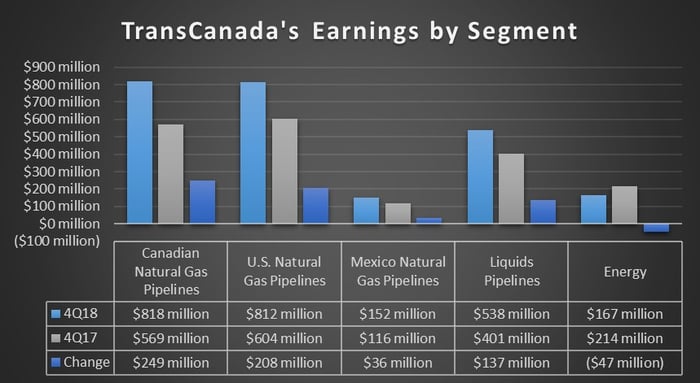
As expected, TransCanada's financial results improved significantly during the fourth quarter, thanks in part to the recent completion of several expansion projects across its diverse asset footprint:

TransCanada's earnings by segment in the fourth quarter of 2018 and 2017

Data source: TransCanada. Chart by author. All figures in Canadian dollars. 

Earnings in TransCanada's Canadian gas pipeline segment surged 44% year over year due to higher rates on the Mainline and NGTL systems. U.S. natural gas pipeline earnings, meanwhile, jumped 34% thanks to the recent completion of expansions projects on its Columbia system, additional sales contracts on ANR and Great Lakes, and the positive impact of U.S. tax reform. The Mexico gas pipeline segment delivered 31% year-over-year profit growth mainly due to the timing of when the company could recognize revenue on those systems. Finally, liquids pipelines earnings rose 34% due to higher volumes on the Keystone Pipeline System and an increased contribution from liquids marketing activities as both volumes and margins improved.

TransCanada's energy segment was the lone laggard as earnings slumped 22% compared to last year's fourth quarter due to a weaker performance at Bruce Power as a result of lower volumes caused by an increase in outages as well as the sale of both Cartier Wind and Ontario Solar.

A pipeline in a green field heading off to the mountains.

Image source: Getty Images.

A look at the outlook

"With our existing asset base expected to benefit from supportive market fundamentals and CA$36 billion ($27.2 billion) of secured growth projects currently under way, approximately CA$9 ($6.8 billion) billion of which is commissioning or nearing completion, earnings and cash flow are forecast to continue to rise," stated CEO Russ Girling in the earnings release. That expanded cash flow should "support annual dividend growth of eight to 10% through 2021," according to the CEO, which led the company to declare an 8.7% dividend increase for 2019.

Girling further noted, "Looking ahead, we will also continue to carefully advance more than CA$20 billion ($15 billion) of projects under development including Keystone XL and the Bruce Power life extension program. Success in advancing these and other growth initiatives that are expected to emanate from TransCanada's five operating businesses across North America could extend our growth outlook well into the next decade."

With such a large slate of capital projects under way and in development, TransCanada has a large funding need that it's working to address. The company is hoping to be able to finance these projects without issuing too much more equity -- which would dilute existing shareholders -- while at the same time maintaining its leverage target. Because of that, Girling noted that the company "continue[s] to progress various portfolio management activities," including by recently announcing the sale of its Coolidge generating station in a deal that will bring in $465 million when it closes by midyear. It's also considering bringing on financial partners to help fund part of the construction of its large Coastal GasLink and Keystone XL projects.

Plenty of fuel to continue growing

TransCanada's expansion efforts paid off in 2018 as it delivered double-digit earnings and cash flow growth, which enabled the company to increase its dividend once again, marking the 19th straight year. There's plenty more growth where that came from since the company has tens of billions of dollars of additional expansions under way and in development. That makes the Canadian pipeline giant an ideal stock for both income and growth investors to consider buying.

Saturday, February 16, 2019

Redwood Trust Inc (RWT) Q4 2018 Earnings Conference Call Transcript

Logo of jester cap with thought bubble.

Image source: The Motley Fool.

Redwood Trust Inc  (NYSE:RWT)Q4 2018 Earnings Conference CallFeb. 14, 2019, 5:00 p.m. ET

Contents: Prepared Remarks Questions and Answers Call Participants Prepared Remarks:

Operator

Good afternoon and welcome to the Redwood Trust Incorporated Fourth Quarter 2018 Financial Results Conference Call. During management's presentation, your line will be in a listen-only mode. At the conclusion of management's remarks, there will be a question-and-answer session. I will provide you with instructions to enter the Q&A queue after management's comments.

I will now turn the call over to Lisa Hartman, Redwood's Senior Vice President and Head of Investor Relations for opening remarks and introductions. Please go ahead.

Lisa M. Hartman -- Senior Vice President, Head of Investor Relations

Thanks, Didi. Hello, everyone thank you for participating in Redwood's fourth quarter 2018 financial results call. Here with me today are Chris Abate, Redwood's Chief Executive Officer; Dash Robinson, Redwood's President; and Collin Cochrane, Redwood's Chief Financial Officer.

Before we begin, I want to remind you that certain statements made during management's presentation with respect to future, financial or business performance may constitute forward-looking statements.

Forward-looking statements are based on current expectations, forecasts and assumptions that involve risks and uncertainties that could cause actual results to differ materially. We encourages you to read the company's Annual Report on Form 10-K, which provides a description of some of the factors that could have a material impact on the company's performance and could cause actual results to differ from those that may be expressed in forward-looking statements.

On this call, we will also refer to both GAAP and non-GAAP financial measures. The non-GAAP financial measures provided should not be utilized in isolation or considered as a substitute for measures of financial performance prepared in accordance with GAAP. They are included to aid investors in further understanding the company's performance and to provide insight into one of the ways that management analyzes Redwood's performance.

A reconciliation between GAAP and non-GAAP financial measures is provided in both our fourth quarter earnings press release and Redwood Review available on the company's website www.redwoodtrust.com.

Also note that the content of this conference call contains time-sensitive information that is accurate only as of today February 14, 2019. The company does not intend and undertakes no obligation to update this information to reflect subsequent events or circumstances.

Finally, today's call is being recorded and will be available on the company's website later today.

I will now turn the call over to Chris for opening remarks.

Christopher J. Abate -- Chief Executive Officer and Director

Thank you, Lisa, and good afternoon everybody. The fourth quarter of 2018 kept a transformational year for Redwood Trust. We laid the groundwork with the strategic initiatives that we outlined at the beginning of the year and we began the early phases of executing on our vision.

The secular shifts we have observed in housing continue to influence consumer behavior and we believe we are well-positioned for the associated opportunities that lie ahead. We are focused on maximizing our strategic value to the housing market by expanding our footprint in areas that optimize our core competencies in housing credit. Competencies that include product development and structuring expertise as well as speed and reliability for our partners. We view this as a path to sustainable and profitable growth for our shareholders.

The end of 2018 brought heighten levels of market volatility, adversely impacting valuations across both equity and credit markets. As a result, our book value declined approximately 3% in the fourth quarter, consistent with the estimated range we previously disclosed last month.

The decline was driven largely by marks in our securities book and overall underperformance of mortgages. The impact of spread widening was cushioned by our modest leverage and by the overall resiliency of our credit-focused portfolio, which remains well supported due to the strong performance of underlying borrowers.

On the positive side, price volatility helps to reinforce the importance of cash flow durability which remains a continued strength of our investment portfolio. As many of you are aware, markets have regained their footing thus far in 2019 and year-to-date we estimate that we have recovered nearly half of last quarter's book value decline.

Our fourth quarter earnings were significantly impacted by mark-to-market adjustments. We are very pleased with the positive trend of our core earnings per share, a great reflection of how our business has been operating. Core earnings for 2018 totaled $1.78 per share, up 27% versus 2017, on a capital base that was almost 20% larger. This in part reflected our ability to put the proceeds from our July equity offering to work accretively.

We are now hard at work doing the same with our subsequent equity raised in January. Additionally, dividends per share for 2018 exceeded the prior year by 5.4%. Central to our efforts is our investment portfolio's continued ability to source and structure opportunities that our competitors cannot easily replicate.

During the fourth quarter, we deployed $235 million into new investments bringing our full year deployment to a record $810 million. Over half of the fourth quarter's investments were sourced on a proprietary basis versus through traditional dealer channels.

Highlighting our investment activity was the completion of our purchase of subordinate securities from Freddie Mac that were backed by reperforming loans, our continued activity in subordinate Sequoia securities and business-purpose real estate loans, and our recent investment in legacy excess servicing that Dash will describe in more detail.

Our efforts in cultivating strategic relationships bore fruit in 2018, and we expect this to be a key differentiator for us moving forward. Our investment suite with Freddie Mac continues to grow, with momentum across both the single-family and multi-family sectors carrying over into 2019.

Exercising our option to acquire the remaining interest in 5 Arches further expands our excess to the business purpose real estate lending space, an area of housing that we believe offers accretable and scalable returns to our shareholders. This acquisition underscores our conviction in this space and our review of 5 Arches operational and cultural fit. We look forward to welcoming the 5 Arches' team into the fall of next month.

While facing similar market headwinds to what we have described before mortgage banking still posted a record year in 2018 with over $7 billion in whole loan purchases. Even though volumes came in at the lower end of our forecasted range full year returns from our mortgage banking platform were above the high end of this range. The mortgage industry broadly has been adapting for several quarters now to the impact of higher rates and an associated slowdown in home purchases and refinance activity.

Our overall performance in mortgage banking in 2018 reflects the diversity of our sourcing and syndication channels and our continued efforts to use our capital more efficiently. These competencies will be increasingly critical as competition for newly originated jumbo loans remains fierce.

Recent news out of Washington regarding GSE reform also continues to command our attention, while the pace of change remains uncertain. Since the New Year, we have seen renewed focus from both the administration and Congress and how the mortgage market should be structured going forward.

An outline provided earlier this month by Senate Banking Chairman Crapo touches on many critical themes including a level playing field for guarantors and sellers. While the potential array of outcome remains quite broad we believe a platform like ours with core strengths and structuring, pricing and syndicating mortgage credit risk stands at a benefit in a market that welcomes more competition.

As we plan for the remainder of 2019, our focus remains in creating durable investment cash flows and at supporting our book value and dividend growth. Our integrated businesses are squarely focused in residential housing credit, an area where we have deep experience and a longer track record than any of our modern-day competitors.

And with that I'll turn the call over to Dash Robinson, Redwood's President.

Dashiell I. Robinson -- President

Thank you, Chris, and good afternoon everyone. The fourth quarter was one of sustained momentum for Redwood across business lines despite the marketwide volatility we saw toward year-end. We took advantage of attractive prices adding several line items to the portfolio at compelling levels. But the main theme continue to be sourcing and structuring our own investments that others cannot easily access.

As Chris mentioned, we believe this type of capital deployment will continue to drive our earnings per share with an eye toward higher sustainable dividends for our shareholders. To that end, the investment portfolio followed a record third quarter with another strong showing in the fourth quarter deploying $235 million of capital and as Chris mentioned, bringing total deployment for the year to a record $810 million.

The investment mix continue to reflect our focus on thicker subordinate positions where we earn an attractive premium versus traditional on-the-run securities in the primary and secondary markets.

During the quarter, we deployed over $50 million into an additional multifamily B-Piece, $30 million to complete our investment in Freddie Mac-issued subordinate securities backed by reperforming loans, and $83 million into a unique opportunity in excess servicing.

As part of the excess servicing investment, we took a majority stake in a newly formed vehicle that owns or is committed to purchase excess servicing cash flows and servicing advances from over 200 legacy non-agency mortgage securitizations with up to $15 billion of total unpaid principal balance.

The average age of the underlying loans is approximately 13 years. Our partner in the joint venture is servicing the loans in the underlying trusts. Unlike newer vintage mortgage servicing rights where returns are more dependent upon voluntary prepayment speeds returns on this investment will likely be driven by the servicer's ability to efficiently work with delinquent borrowers an ongoing credit performance of the loans overall.

The joint venture is utilizing nonrecourse debt to help finance the acquisition of the associated servicing advances. Other capital deployment for the fourth quarter included $22 million in Agency CRT bonds $12 million in mezzanine and multifamily securities issued by Freddie Mac and $21 million in RMBS including securities from the Sequoia transaction we completed the quarter.

Going forward we remain well-positioned to continue expanding our presence in the areas of housing where our capital can be put to work most accretively. Following up on our most recent multifamily B-Piece investment, earlier in the first quarter, we completed our participation in the fund set up to purchase short-term floating rate light renovation multifamily loans from Freddie Mac.

Over time there will be the opportunity to convert the fund investment into subordinate securities issued from our Freddie Mac-sponsored securitization. Our commitment $78 million in total was only 25% funded at close representing a subsequent capital deployment opportunity in the coming months.

Additionally, we continue to advance our efforts in the business-purpose real estate lending space. As Chris mentioned, in January, we announced our decision to complete the full acquisition of 5 Arches, a specialty lending platform focused primarily on single-family bridge and single-family rental loans. This represented the culmination of over 12 months of working with the 5 Arches teams, allowing us to validate our market thesis and confirm cultural and operational fit.

The 5 Arches platform has continued a strong trajectory finishing 2018 with over $800 million in total originations including over $200 million in the fourth quarter. Volumes had exceeded our expectations when underwriting the initial investment. Completing the transaction will allow us to earn the full economics associated with the bridge and single-family rental products, including borrower points and gain on sale, the latter of which may become increasingly compelling as financing markets for these asset types continue to mature.

Most importantly, the acquisition provides us access to all of 5 Arches' loan production allowing us to continue creating accretive credit investments for our portfolio. As Chris mentioned, we believe 5 Arches' core competencies will become increasingly relevant to the housing market and enhance our overall value to the marketplace. I echo Chris in welcoming their team onto our platform.

Additionally, during the fourth quarter, we continue to opportunistically rebalance the portfolio rotating out of lower yielding assets, capturing $9 million of previously unrealized gains and freeing up approximately $58 million of capital for redeployment. Portfolio sales were focused in season Agency CRT securities and mezzanine RMBS.

Our mortgage banking platform continue to execute effectively in the fourth quarter managing headwinds that have continued into 2019. While mortgage rates dipped late in the year and have remained relatively steady year-to-date, industry volumes have remained under pressure as the overall pace of home buying slows and most existing borrowers still have rates below those available today.

As Chris described, we will continue to manage the business in anticipation of increased overall competition for what may be lower overall industry origination volumes in 2019. During the fourth quarter, we generated margins in excess of our long-term expectations of 75 to 100 basis points, driven by our ability to utilize both securitization and whole loan channels to distribute risk.

In addition to completing one Sequoia securitization in fourth quarter or 12th for the year overall, we sold over $800 million of loans for the second consecutive quarter helping to fill what remains strong demand for prime jumbo loans from portfolio lenders. We often speak of the value of keeping our whole loan sales channels open and active even when securitization markets are particularly favorable. The second half of 2018 validated that approach and we expect to continue deepening these partnerships in 2019. Additionally, our sourcing channels remain well diversified with a base of over 190 sellers.

In the fourth quarter, our overall mortgage banking purchase volumes moved in step with the broader markets totaling $1.6 billion, a decrease of approximately 13% from the third quarter. That said, full year volumes were 20% higher than in 2017 and full year Redwood Choice volumes of $2.3 billion were almost 75% higher than the prior year. This reflects what we believe is a continued deep addressable market of high-quality borrowers.

The nature of our pipeline in the fourth quarter continue to reflect the overall market trend of heavier purchase money volume. 73% of our volume represented purchase money transactions similar to the third quarter and up 64% for full year 2017.

Now to recap our financial results, I'll turn it over to Collin.

Collin Lee Cochrane -- Chief Financial Officer

Thanks, Dash. And good afternoon everyone. To summarize, our financial results for the fourth quarter, our GAAP earnings were negative $0.02 per share compared with $0.42 in the third quarter and core earnings were $0.39 per share consistent with the third quarter. Our loss in the fourth quarter was primarily driven by negative market valuation adjustments in our investment portfolio resulting from spread widening late in the year.

Core earnings reflected growth in portfolio, net interest income from continued capital deployment and solid mortgage banking results which were partially offset by lower core gains relative to the prior quarter.

For the full year GAAP earnings were $1.34 per share and core earnings were $1.78 per share. Our core earnings were driven both by strong mortgage banking results and by record capital deployment in our investment portfolio which contributed to a 13% increase in economic net interest income in 2018, along with meaningful gains as we continue to optimize our portfolio.

Looking forward to 2019, we're focused on continuing to grow economic net interest income through accretive capital deployment and portfolio optimization, but could see lower gains, given the portfolio's current composition. Our GAAP book value declined approximately 3% during the fourth quarter to $15.89 per share, primarily due to the negative market valuation adjustments on our investments.

Adding back our dividends, we generated an economic return of negative 1.4% for the quarter which brought our full year economic return to positive 7.8%. As Chris mentioned cash flows and credit fundamentals in our investment portfolio remains strong. And since year-end, we have seen credit spreads begin to firm up.

Similar to the third quarter, we completed several new investments in the fourth quarter that continue to change the complexion of our balance sheet. As Dash mentioned, we added to our multifamily B-Piece investments during the quarter and invested in the securitization of seasoned reperforming loans. Those securitizations are now consolidated onto our balance sheet. Additional information on these investments and their impact to our financial statements is included in our Redwood Review.

Shifting to the tax side for a moment, our total taxable income was $0.37 per share in the fourth quarter, a decrease from the third quarter mainly reflecting lower income from our TRS. Focusing specifically on REIT taxable income, we finished the year with $1.38 per share for 2018. This exceeded our dividends of $1.18 per share for the year and as a result we expect to utilize approximately $16 million of REIT NOL for 2018, leaving us $39 million to carry forward.

Turning to the balance sheet and our capital position, after raising approximately $25 million under our newly established ATM program during the fourth quarter and taking into account net capital deployment, we ended the year with around $85 million of capital available for investment.

Moving into 2019 with the proceeds of close to $180 million from our recent equity follow-on offering and after taking investment activity into account, we estimate that at the end of January we had approximately $190 million of capital available for investment. We expect the majority of this capital to be deployed toward investments in multifamily loans and securities, the securities issued offer a Sequoia shelf. Business purpose real estate loans and other mortgage credit assets.

Regarding leverage, our recourse debt-to-equity leverage ratio was 3.5 times at the end of the fourth quarter. While this increase from the end of the third quarter due to capital deployment and a higher balance of loans held for sale, we estimate that subsequent to our equity raise this has come back down to around 3.1 times. We generally expect to continue to operate with a recourse to leverage ratio closer to 3.5 times once the proceeds from our equity offering is fully deployed.

I'll close with the 2019 financial outlook. For 2019 we remained focused on increasing our capital deployment across the broader housing credit market, pursuing investments that drive higher net interest income and overall returns for shareholders. Building off new operational efficiencies and being responsive to market conditions, we expect to relocate capital from our mortgage banking business toward REIT-eligible investments in our portfolio.

More details on the specifics for each of our business lines are included in the Redwood Review. Separately, I want to touch briefly on our recent announcement to complete the full acquisition of 5 Arches. We expect to close this transaction in early March and plan to incorporate 5 Arches into our financial statements in the first quarter of 2019.

As a reminder, we initially invested $10 million in 5 Arches in May of last year to purchase a 20% minority investment. Incremental consideration for the full purchase will be $40 million, which is less than 2% of our overall capital base and will be paid in a mix of cash and stock with a substantial portion contingent on production volumes over the next two years.

5 Arches was profitable in 2018 and while we expect our direct platform investment to be accretive to earnings in 2019. The larger impact will come from the access this gives us to the growing originations pipeline. With this investment, we believe we can deploy $200 million to $300 million of capital and business-purpose loan investments that will generate returns in the low to mid-teens.

In terms of how this will impact our financial statements as a capital lead operating business with close to 100 employees adding 5 Arches will bring a new stream of fee revenues into our earnings along with expenses to support activities in our operating expenses. We'll have more details on these amounts when we report our first quarter results in April.

And with that, I'll conclude our prepared remarks. Operator, why don't we start the Q&A?

Questions and Answers:

Operator

Thank you. (Operator Instructions) We'll take our first question from Doug Harter with Credit Suisse.

Doug Harter -- Credit Suisse -- Analyst

Collin just wanted a clarification on that kind of available capital number. Does that include -- that $190 million does that factor in the $40 million or so to pay for 5 Arches later this quarter?

Collin Lee Cochrane -- Chief Financial Officer

That does not include the 5 Arches but it does include the commitments we entered into in the fourth quarter that have not been fully funded yet. So those have been taken into account in that number. But not 5 Arches. It can only -- a portion as the 5 Arches (technical difficulty) is in cash Doug. So there is a portion that that will be funded in equity.

Doug Harter -- Credit Suisse -- Analyst

Okay. Got it. So I shouldn't think of the -- as a full $40 million reduction to that number?

Collin Lee Cochrane -- Chief Financial Officer

That's right.

Doug Harter -- Credit Suisse -- Analyst

Got it. And then I guess as you think about the ability to continue to sort of optimize the investment portfolio going forward, I guess, how much more activity do you think you could see there and what types of return pickups do you typically see as you're rotating into newer assets?

Dashiell I. Robinson -- President

Sure. Hey, Doug its Dash I can take that. That's obviously, a dynamic process depending upon, where market prices are in general. I would say that, absent events like the volatility we saw on the fourth quarter, the investment that we have again driven by the continued strong performance they tend to roll down the curve very, very well. And so every quarter as these positions season many get upgraded many of our subordinates Sequoia bonds get upgraded as they continue de-lever in season. You start to see yields compress. And so in many cases, the bonds that we sell yields mid-high single digits and we're redeploying that capital into low mid-double-digit returns.

So that's obviously not always going to be the math. But when you think about, what we've historically optimized and when you think about where we're putting incremental capital to work and a lot of things that the three of us described a few moments ago, that's generally the strategy when we think about repositioning the portfolio.

Doug Harter -- Credit Suisse -- Analyst

All right. Thanks. And then just last one for me. I guess, given kind of the recovery in markets so far in the first quarter, and I guess, how are you looking at kind of the execution between whole loan sales and securitization?

Dashiell I. Robinson -- President

Yeah. The securitization markets have firmed up a bit since the end of the year. I would still say on balance, we see favorable conditions in both. We did sell over $1.5 billion of whole loans in the second half of the year, we're continuing to pursue those paths.

We're always going to look at it on a best execution analysis. We'll continue to do that. We've completed one Sequoia transactions this year. We anticipate doing others. We are about to have a deal on the market as well for Choice. But beyond that I think there continues to be really strong demand from whole loans -- from whole loan buyers, which we're going to continue to avail ourselves of.

Christopher J. Abate -- Chief Executive Officer and Director

Yeah. I would Doug that I think a year ago the securitization market relative to whole loan market was meaningfully stronger. We completed 12 Sequoias last year. This year they're much closer in parity.

So it's not going to be as obvious what we do with loans. The good news is as Dash mentioned, they're both profitable and having multiple forms of distribution will allow us to continue to optimize that execution.

Doug Harter -- Credit Suisse -- Analyst

Thank you.

Operator

(Operator Instructions) And we'll go next to Bose George with KBW.

Eric Hagen -- KBW -- Analyst

Hey, thanks. Good afternoon. This is Eric on for Bose. A follow-up on the capital deployment. Just maybe you can give us some detail around the time line for the $190 million and as a side card of that just maybe walk through the levered returns that you're seeing across the menu of investments that you'd be looking at to deploy that into? Thanks.

Dashiell I. Robinson -- President

Sure. Thanks, Eric. This is Dash. We are already actively deploying those proceeds that we raised few weeks ago. I touched on a few of those including the multi-family fund with Freddie Mac, which is a real-time capital deployment opportunity, which we continue to invest in real time similar to the excess servicing investment, I described there is incremental capital to be deployed there.

So we expect as we mentioned when we did the offering a few weeks ago, we expect that capital to be deployed fully within the next three months. But it is -- we are hoping to front-load that as much as possible obviously with the opportunities we have in front of us and that are available in the market.

I would say returns are consistent with what I articulated in response to Doug's question, low to mid double-digits on capital are what we're seeing and what we project. In some cases, we are using leverage on those investments, and sometimes not there's sort of a variety there. So that's how we see things generally in terms of the deployment opportunities.

Eric Hagen -- KBW -- Analyst

Got it. That's helpful. Thanks. And then maybe you can just kind of tease apart for us the impact of credit spread widening in the Sequoia portfolio versus the third-party investment string the last quarter?

Dashiell I. Robinson -- President

Yes, I would say the majority of the spread widening was away from Sequoia. Some of the mezzanine securities that we hold certainly did have spread widening those are generally long-duration securities and so they contributed to some of the book value movement we had in the quarter. Away from that largely it was some of the CRT investments that we have as well as some of the mezzanine securities we hold from Freddie Mac multifamily as well as within the FHLB book as well in terms of how mortgages overall performed during the quarter. Those are more of the areas that drove it.

Obviously, as Chris articulated from a credit-performance perspective we continue to feel really good about all those investments whether it's Sequoia or third-party. But that's really where the majority of the book value movement came from.

Eric Hagen -- KBW -- Analyst

Got it, great. And then last one just maybe you can give us some color on how much of a rate incentive current jumbo borrowers have in your portfolio and maybe even across the market would be helpful too? And then how should we think about the earning sensitivity of that jumbo portfolio given a pickup in refi activity? Thanks.

Christopher J. Abate -- Chief Executive Officer and Director

Yes, I mean, so mortgage rates have gone lower on a relative basis, but candidly, they're still high enough that we don't expect any significant amount of refinance activity in the near-term that would move our book or our business in one direction or the other.

I think we expect it to be -- it continues to be something like a 70% purchase split between purchase and refi activity. The one thing I'd say on the mortgage banking business is we're very focused on capital turnover and efficiency at this point. So, it's continuing -- as the portfolio expands, it's continuing to become a smaller capital footprint for us. And we certainly expect to earn double-digit returns in that capital.

But as far as the swings in refinance activity or mortgage rates goes we actually expect that to have a less meaningful impact on overall portfolio book of business which is good from our perspective because we tout the durability of cash flows and some of the stability we've been able to add over the past few quarters.

Despite the fact we took -- assuming if we can amount to mark-to-market adjustments in the fourth quarter on a relative basis from an industry perspective 3% decline in book value was actually quite modest. So that's where we're gearing toward. And you will probably have better information on next quarter's call as the spring selling season takes hold and we see if people come out to buy homes.

Eric Hagen -- KBW -- Analyst

Got it. Thanks Chris. Maybe I can press you on your book value quarter-to-date?

Christopher J. Abate -- Chief Executive Officer and Director

I think we mentioned we think as far as spreads go we have recovered about half. So, I'd say all else equal, there's a lot of things that impact book value, but from a mark-to-market adjustment perspective, we've recovered about half of the spread widening that we incurred in the fourth quarter.

Eric Hagen -- KBW -- Analyst

Super. Thanks guys. Appreciate it.

Christopher J. Abate -- Chief Executive Officer and Director

Thanks Eric.

Operator

And next we'll hear from Steve Delaney with JMP Securities.

Steve Delaney -- JMP Securities -- Analyst

Thank you and congratulations to the new team for a strong start in your first year. I guess I've heard comments about headwinds and refis. I'm curious last year you started the year with a goal of $7 billion to $8 billion of purchase volume in your core prime channel. I was curious are you thinking about providing any targets or guidance at some point as the year goes along? Or is it kind of a wait-and-see situation? Thanks.

Christopher J. Abate -- Chief Executive Officer and Director

Hey, Steve, it's kind of a wait and see. At this point, we think that volume will be down from last year. We don't think that the -- there's still a lot of cyclicality in the market and there's still a lot of capacity that needs to be corrected. There's strong demand for money center banks. So what we don't want to do is, we don't want to chase volume.

I think what we're most focused on is being really, really efficient. So some of the metrics we'll talk about is capital and turnover and operating efficiencies. We've got a tremendous platform, it's incredibly valuable and critical to what we do.

We're absolutely committed to our mortgage banking initiatives for the long run. But we've seen this happen many times, it's a cyclical business and we just want to make sure we're positioned for the long run. And I think right now, if volumes are lower than last year, that's OK with us.

Steve Delaney -- JMP Securities -- Analyst

Yeah. And then definitely here in the point -- the theme of creating long-duration proprietary investments rather than maybe allocating capital, just to support volume and definitely more of an investment rather than a volume focus, for sure, that's coming through loud and clear.

You did in your 5 Arches handout, can't remember what that was, a month or so ago when you announced that, you did mention $900 million to $1 billion there in the BPLs. And I'm just curious, is there a sort of a framework for that production? How you plan to finance or structure that? And do you see any of their production being sold off on a whole loan basis? Or is it all for your balance sheet?

Dashiell I. Robinson -- President

Thanks, Steve. This is Dash. Those are great questions. In terms of financing, I would say a few things. For single-family rental, the plan remains to avail ourselves of long-term non-recourse financing in that space, as we reach critical mass. We're currently financing those loans with two warehouse lines in the same way we refinanced our jumbo production before those go into Sequoia transactions.

I would say, there are opportunities both in the rated securitization space as others have tapped as well as interest from other more private lenders in a similar environment, where we could effectively term out on a non-recourse basis our investments there. So we're assessing both of those and they both have efficiencies as we continue to ramp the portfolio.

The short-term bridge is a story that's evolving as well. We're currently financing those loans on multi-year warehouse lines. To answer your second question, we intend to begin stepping in and speaking for more of their production. They do currently sell some loans away and we're currently assessing what the right mix of that is going forward, considering demand for these loans in the market remains very, very robust, particularly given their short duration and relatively high coupons. So that's something we'll have eyes and keep our options open for.

As Collin articulated, the opportunity to deploy more capital, and we put $200 million to $300 million range out there, is extremely compelling to us. But similar to the way we run the jumbo business, it's constantly looking at the market and trying to identify efficiencies and where other buyers are bidding this paper versus where we can create our own investments. And I think the analysis for the bridge product will be very, very similar.

I would say that one piece that's evolving in that market is securitization. There have been a handful of -- to this point, unrated securitizations done in the bridge space, some of them revolving where the issuer is allowed to replenish repayments and some have been static. The metrics there appear very compelling versus where a traditional warehouse repo is available, and so we're assessing that.

It will probably a bit of time before we feel like we're ready to go and actually securitize these loans as you know there's a lot that goes into that preparation. But that's something that we'll certainly keep a close eye on and plan toward. So I think we're going to keep our options open. We would certainly love to speak for the majority if not all of their production. But we're going to do what's in our best economic interest. And again for what we feel is a relatively modest acquisition price we feel like we have a lot of attractive options with their platform and with the market in general.

Steve Delaney -- JMP Securities -- Analyst

That's great color. And I can tell you guys have thought through this and you do have a lot of optionality as you mentioned. My final point just to close out on, you got to read the shareholder letter, I've read that over the years with Redwood if don't read all 50 pages of the review. But there were several comments in there about higher sustained dividends over time. And I think about your current dividend it's -- works out to about 7.5% yield on book value.

And I'm just curious if you guys have a goal or a target of where you think you'd give yourself another couple of years of trying to optimize things. Do you feel that there is room to move the dividend to where it would offer a higher yield on your book value something more in the maybe the 9% to 10% range? Just curious if that seems realistic to you guys?

Christopher J. Abate -- Chief Executive Officer and Director

Steve, I mean I can tell you we are engineering toward that. I don't want to be overly provocative and cite a number or commit ourselves to anything certainly without our board. But as far as how we're thinking about the portfolio in our capital allocation bolting on different asset classes within housing. And when you put it all together we're very, very conscious of the yield on the book and sustainable cash flows which drive sustainable dividends.

So it's a very much a goal of ours. We cited it. You cited it correctly in the shareholder letter. I think as we see economic net interest income go up which is something we're focused on through capital deployment. We'll have more and more durable cash flows and be in a position hopefully to do that. But it is very much a focus of ours to get the yield higher.

Steve Delaney -- JMP Securities -- Analyst

Great. Well thank you for the comments. Appreciate it.

Operator

(Operator Instructions) And our next question will come from Stephen Laws with Raymond James.

Stephen Laws -- Raymond James -- Analyst

Hi good afternoon. Thanks for taking my question. A lot have been hit on, but I want to follow up on two. I guess both just asked by Steve, but on the flip side of that I think covered the asset and the leverage capital for business-purpose loans. Can you talk about the 5 Arches acquisition, how that rolls into operating expenses? I think if I hit the right point in the review, I think you guided to like $48 million or $50 million of kind of operating expenses for this year.

Does that include the 5 Arches for the pro forma expected of 10 months? Is that not included and if not how much should we think about adding to the operating expense to reflect that?

Collin Lee Cochrane -- Chief Financial Officer

Yes, Stephen this is Collin. The number that we have in the review and the outlook is actually just our corporate overhead. So the operating expenses associated with each of our business lines are included in the returns that we give the projections for the business line. So that number is just a component of our overall expenses. And it doesn't include any expenses for 5 Arches either. That will end up once we kind of work through and figure out how we're going to integrate into the segments that will integrate into one of the business lines, and so that will be separate from our corporate operating overhead.

And we weren't planning on providing any additional numbers on the call today, but we will be providing numbers as I mentioned in terms of how to think through 5 Arches in our consolidated financial statements in the first quarter.

One of the points I made in my script was that when you step back at a high level when you look at the investment of 5 Arches, it's just under 2% of our total capital. So the overall net impact setting aside the gross revenue and gross expenses that will bring on just from the underlying business platform itself won't move the needle meaningfully from the get-go.

So the more meaningful part as Dash discussed is going to be from the investments that are generated from that business that move into the portfolio. So, again we'll have some more detail on that in the first quarter, but the number you're seeing there is just the corporate overhead.

Dashiell I. Robinson -- President

Stephen, it's Dash. One thing I would just add on that quickly is 5 Arches was profitable in 2018 and the numbers that we have been quoting here and that we put in the little -- in the pack that we provided when we announced the intention to move forward and acquire the rest of the platform those are more of the raw asset returns that don't include the other additional economics that I mentioned in the prepared remarks that internalizing the economics of 5 Arches can bring to bear.

So as Collin articulated we'll have a lot more to say after the transaction closes when we talk about the first quarter. But a -- I just want to reinforce a couple of those points as well.

Stephen Laws -- Raymond James -- Analyst

No, great I appreciate that. And then looking at the opportunity is this what you need to fully be in the business-purpose loan space? Or you're out there looking for other partners or other acquisitions? Is this a platform that I think heard earlier maybe $900 million to $1 billion from the presentation a month ago in loans? Can you grow that to where you want to get to for an annual basis? Or do you need to continue to make acquisitions to add on to this business line?

Dashiell I. Robinson -- President

Yeah, I don't know. Obviously we'll always keep our options open. I would say for the next little bit everyone's plate is quite full of making sure that this integration goes properly and we onboard the platform onto ours in a prudent way. So that is, obviously, our main focus for the next little while.

I don't think expanding this effort needs to involve M&A. As we've talked before there are opportunities to roll these products out through our existing seller network there are other originators of these sorts of loans that we talk to and could potentially become correspondence of us via 5 Arches. And so I think what that platform brings us is a very attractive competency in terms of the ability to originate the borrower network.

The vast majority of their production is with repeat borrowers the majority of the production is in-house they do have brokerage relationships. And there's a lot we can do with that existing platform to grow it. There's a lot we can do with our existing network within mortgage banking that won't involve M&A that can help drive volume and that's really where we're going to be focused initially. Secondarily of course to making sure that this integration goes smoothly.

Stephen Laws -- Raymond James -- Analyst

Great. And then one last just as a follow-up on the dividend. It looks like in the review I think it says REIT taxable income for the year is estimated to be $1.38. So, I guess you distributed around 85% of REIT taxable income. Kind of -- I don't want to get too lost in the pennies but from a bigger picture over the last I guess I've been around the story 15 years and you've had a period where you paid large special dividends there's been other time periods where you've roll forward the first three quarters of the next year's dividend and kind of the go forward of taxable earnings. Can you talk about -- and I know Chris -- I think it was Chris who commented high level on this but -- as far as dividend growing but can you talk about where you are as far as any kind of requirements of distributions are there still NOLs that get you to 90%? Are you spilling money over? Are you considering special dividends? Kind of how do we think about the larger picture dividend policy of the company going forward?

Christopher J. Abate -- Chief Executive Officer and Director

Hey, Stephen it's a great question. And we had previously announced our intention -- the Board's intention on dividends. And last year we didn't do our intention, we exceeded it. So, we were happy to raise the dividend last year for the first time in a number of years.

It's a very important piece of our story for this management team to continue to try and get that dividend higher. As far as REIT taxable income goes, certainly, we're very focused on it very focused on growing it. And we still have a $30 million -- $39 million NOL at the REIT that we can use. But I would say, overall, it's not a major factor in our long-term thinking.

I think what we're trying to do is drive that dividend higher by growing net interest income and really focusing on the durability of our portfolio cash flows. We're trying to grow the portfolio to grow the dividend and really scale the platform. So, I think on the ground level, it does get back to the capital deployment activity of the company which we're happy to say is up. And we did deploy a record amount of capital last year.

If we're able to continue that pace of deployment and continue to grow the book, we certainly think the math will pencil out to drive that dividend higher. Whether it's in the form of higher regular dividends or special dividends that's something we would need to take up with the Board.

But I do think that REIT taxable income unlike more recent years is becoming once again a very relevant metrics for us and certainly to the management team. So, it's something -- it's certainly something to follow in the coming quarters.

Stephen Laws -- Raymond James -- Analyst

Great. Thanks for the color there and congratulations on expanding your business. I'm looking forward to hearing more about it at the Investor Day in March.

Christopher J. Abate -- Chief Executive Officer and Director

Fantastic.

Operator

And there are no further questions in the queue. I'll turn the call back over to Chris Abate for closing remarks.

Christopher J. Abate -- Chief Executive Officer and Director

Thank you, Didi. And to follow-up on Stephen's remark, we actually have a lot to look forward to next year including celebrating Redwood's 25th anniversary as a public company, so we are excited about that.

We're excited to be asked to ring the opening bell at the New York Stock Exchange on Tuesday March 12th. So, we hope you all tune in to see that. Additionally, that same week we will be hosting our second Annual Investor Day in New York City. The Investor Day will be on Thursday, March 14th. So, please contact our Investor Relations department for information on how to participate. And thank you again for joining us today. We look forward to seeing you guys in March. Thank you.

Operator

And that concludes today's conference call. We thank you for joining.

Duration: 48 minutes

Call participants:

Lisa M. Hartman -- Senior Vice President, Head of Investor Relations

Christopher J. Abate -- Chief Executive Officer and Director

Dashiell I. Robinson -- President

Collin Lee Cochrane -- Chief Financial Officer

Doug Harter -- Credit Suisse -- Analyst

Eric Hagen -- KBW -- Analyst

Steve Delaney -- JMP Securities -- Analyst

Stephen Laws -- Raymond James -- Analyst

More RWT analysis

Transcript powered by AlphaStreet

This article is a transcript of this conference call produced for The Motley Fool. While we strive for our Foolish Best, there may be errors, omissions, or inaccuracies in this transcript. As with all our articles, The Motley Fool does not assume any responsibility for your use of this content, and we strongly encourage you to do your own research, including listening to the call yourself and reading the company's SEC filings. Please see our Terms and Conditions for additional details, including our Obligatory Capitalized Disclaimers of Liability.